A cheaper catalyst for producing energy from hydrogen

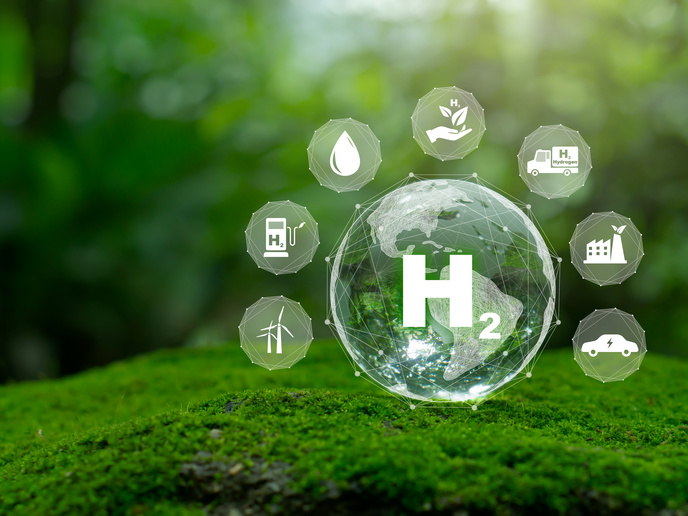
Thanks to its unique combination of scalability, long-term storage and portability, hydrogen has emerged as a promising source of renewable energy. But turning this promise into progress first requires that we not only are able to produce hydrogen from water and energy from hydrogen but can do so in a cost-effective way. For that, there’s the EU-funded HighHydrogenML(opens in new window) project. “Our goal is to find cheap, non-scare materials that can serve as catalysts for two of the main reactions involved in producing hydrogen and generating energy, namely, hydrogen evolution reaction and oxygen reduction reaction,” explains Valentin Vassilev-Galindo(opens in new window), the Marie Skłodowska-Curie Actions(opens in new window) postdoctoral fellow co-leading the project at the IMDEA Materials Institute(opens in new window).
Discovering new potential catalysts
According to Vassilev-Galindo, the hydrogen evolution reaction (HER) and oxygen reduction reaction (ORR) are typically catalysed using platinum (Pt) based materials. “The problem with these materials is they tend to be quite expensive,” he says. “As an alternative, we combined computational chemistry and artificial intelligence to propose new, more cost-effective catalysts for both HER and ORR.” Specifically, researchers conducted density functional theory (DFT) calculations to obtain a dataset of adsorption energies of the adsorbates involved in HER and ORR for a range of materials. DFT is a computational method used in quantum chemistry to study the electronic structure of many-body systems such as atoms, molecules and solids. Adsorption is the process where molecules, atoms or ions adhere to the surface of a material, distinct from absorption, where they enter the bulk of the material. This dataset was then used to train machine learning models to predict the adsorption energies with DFT accuracy at a fraction of the computational cost. The models were later used to screen a list of unknown materials to select those featuring adsorption energies similar to Pt. “These predictions allowed us to find new potential catalysts that were synthesised and tested by experimental colleagues, with the best one reaching up to 71 % of the Pt efficiency for the HER,” adds Vassilev-Galindo.
Using AI to discover new materials
The project also developed an explainable artificial intelligence (XAI) strategy to discover new materials that could serve as catalysts for the HER and ORR. “Up to now, all AI-driven methods were only focused on finding materials with the desired property,” notes Vassilev-Galindo. “Now, with our proposed XAI strategy, it could also be possible to gain insights into what makes a given material better than others and obtain an unprecedented chemical and physical understanding of the properties of materials.”
Making hydrogen energy a reality
The project’s work represents an important step towards making the widespread use of hydrogen energy a reality. “HighHydrogenML is one piece of a big puzzle that will eventually provide sustainable energy through an efficient and affordable hydrogen economy,” concludes Vassilev-Galindo. Vassilev-Galindo plans to continue developing and applying XAI approaches to tackle computational chemistry challenges, as well as to gain new insights into the chemistry and physics of molecules and materials. His hope is that this work will lead to knowledge and discoveries that have a positive impact in industry, health, the environment and society in general.