



Virtual screen takes driver awareness and safety to the next level

One person is killed every 40 seconds using a mobile phone while driving. Every year, distracted driving results in about 1.4 million driver fatalities and over 750 000 serious injuries around the world.
Unlocking the safety benefits of augmented reality
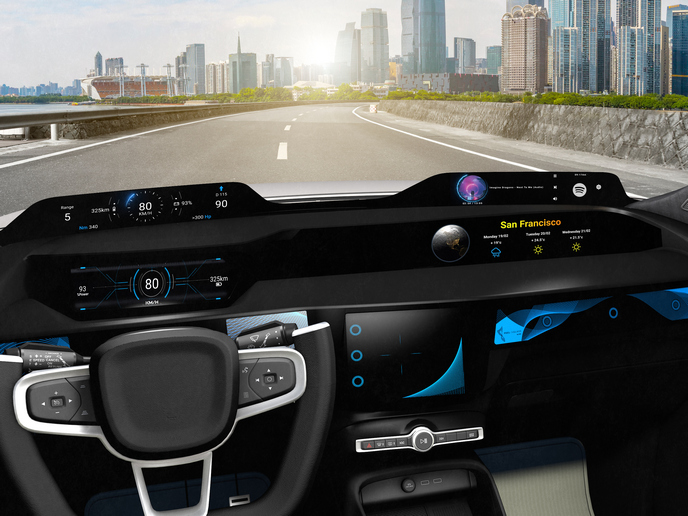
Augmented reality (AR) technology can help drivers to avoid distractions and enjoy greater situational awareness. One promising solution is the AR head-up display, a virtual screen that shows important information such as speed, directions and warnings on the windshield, without having to look down at a dashboard or phone. Despite their growing popularity, head-up displays do not fully meet price and performance requirements. Industrialisation and integration of existing head-up displays are both difficult and expensive. The Vision - Augmented Reality Windshield Display project funded by the European Research Council(opens in new window), introduced cutting-edge virtual screen technology to provide drivers with an overall richer, safer and more immersive experience. “The goal was to develop the AR windshield projection standard, turning any windshield into a virtual display,” says Romain Duflot, founder and CEO of the French start-up EyeLights(opens in new window), a pioneer in AR for mobility that coordinated the project.
The future of driving – right in front of you
The newly developed virtual screen consists of a picture generating unit located inside the dashboard that generates a virtual image through the windshield. It is visible to drivers and passengers. The projector sends an image through a special windshield that has a polarised coating at the inner face – the side that faces the system’s internal components, typically featuring the light source and a display panel. This coating reflects the image into the driver’s eyes and generates a virtual image that makes it look as if it is far away. The innovation promises lower integration packages, superior brightness, a big eyebox – the area in which the driver is able to view the entire display – and greater field of view compared to technological solutions already on the market. The technology can be adapted to any windshield size, shape and curve. It can also be applied to other mobility industries, especially the motorcycle, aerospace and military sectors.
Safety in the sightline
The virtual screen is much safer than its conventional counterparts, with up to 32 % better reaction time based on road safety organisations and automotive manufacturers. It offers more optimal driving comfort, while taking into consideration the needs of the visually impaired and persons with disabilities. The image magnification reduces the CO2 footprint because less resources are used to generate larger displays. The patent-protected technology was awarded by seven original equipment manufacturers in Germany, Italy and Japan. The product was launched in series production by German auto giant BMW on the Neue Klasse – a new generation of electric vehicles starting in 2026. “The developed technology has laid the foundation for all vehicles that will use embedded AR displays,” concludes Duflot. “This technology will finally replace regular screens with virtual ones.”