Brussels Airport’s path to greater sustainability

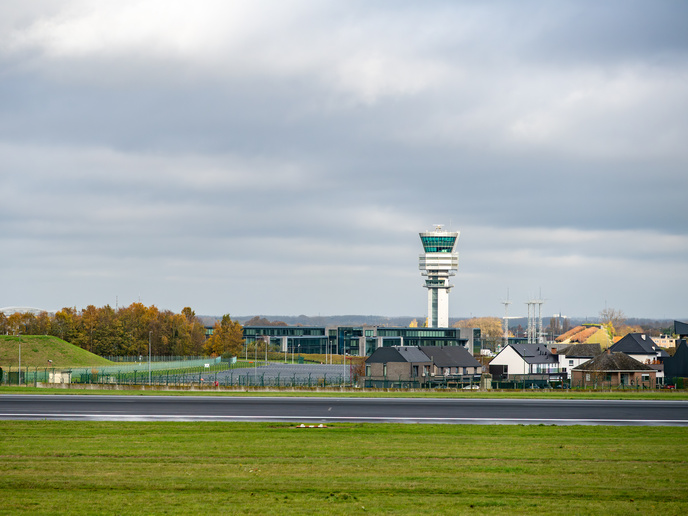
Since 2021, Brussels Airport has been testing innovative mobility and energy solutions with the potential to make airport operations more sustainable. These innovations are part of the EU-funded STARGATE(opens in new window) project aimed to help create the green airports and aviation of the future. One of the solutions tested at the airport is a fully autonomous, electric shuttle, the “first of its kind in Belgium,” according to a news item(opens in new window) posted on the ‘Aviation Direct’ website. The shuttle is equipped with cameras and sensors, and it was initially tested on the airside – the airport’s restricted zone beyond the security checkpoints – from late 2024 to early 2025. It is now undergoing its second testing phase, running between the airport terminal and an employee parking area. Another innovation is the exploration of new uses for locally generated energy. The news item reports that at the start of 2025, approximately 100 homes from four communities in the vicinity were offered locally generated electricity from the airport’s solar panels for an entire year. During this trial phase, which ends in February 2026, STARGATE will assess whether such community energy projects are feasible and scalable. STARGATE also plans to transform staff and passenger transport at Brussels Airport. “A multimodal travel planner evaluates transport options based on various criteria and assists passengers and staff in planning their journeys,” the news item states. In the summer of 2025, the airport also introduced a new bicycle rental system for its 30 000 or so employees. An estimated 48 bicycles, almost half of which are electric, are available for rent at five stations. As the project enters its final stretch until October 2026, additional solutions will be trialled at the airport, including an autonomous cargo transport vehicle and a mobile fuel blending plant. At the same time, similar STARGATE initiatives are being carried out at different partner airports across Europe. The electrification of airside areas is being tested at Athens International Airport Eleftherios Venizelos, an airport mobility plan is being developed at Toulouse-Blagnac Airport and a new navigation app to improve airside vehicle safety has been introduced at Budapest Airport.
Exploring aviation fuel alternatives
The project has also launched a new study on hydrogen infrastructure at airports, its aim being to create a roadmap for the rapid adoption of liquid hydrogen before the 2040 timeline envisioned by the aviation industry. The study focuses on gaseous hydrogen refuelling technologies deployable in the short and medium term, and it will explore both airside and landside (public access zone) demand. Together with STARGATE partners To70 and Hasselt University, Brussels Airport has also worked on the development of a sustainable aviation fuel (SAF) pilot. The STARGATE (SusTainable AiRports, the Green heArT of Europe) pilot successfully procured a volume of blended SAF precisely equivalent to the emissions generated by project partners flying to the project’s general assembly in Toulouse – an action expected to mitigate around 10 tons of CO2. This will establish an airport-led model for the group purchase and delivery of SAF, leading to a standardised, replicable blueprint that can be adopted by fellow airports in Athens, Toulouse and Budapest. For more information, please see: STARGATE project website(opens in new window)