




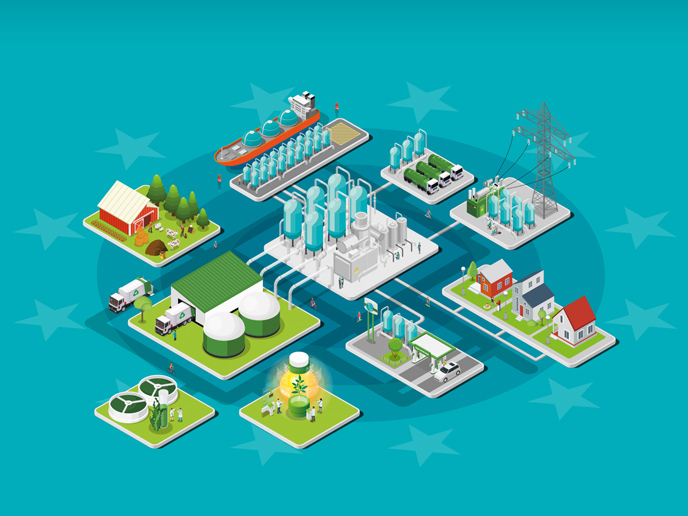
Events in the past year affecting the supply of Europe’s gas imports have made clear the need for the EU to diversify its energy portfolio. REPowerEU(opens in new window) is the European Commission’s plan to erase Europe’s dependence on Russian fossil fuels by 2030 by increasing European biomethaneBiomethaneis chemically identical to natural gas, but produced sustainably from renewable sources such as biomass. production tenfold, to 35 billion cubic metres annually of a sustainable, cheaper and locally produced renewable alternative. The projects in this Pack showcase the advanced technologies that will help deliver on this objective. For more than a decade, the Directorate-General for Research and Innovation has been supporting projects working towards this goal of increased biomethane production, funded through the Horizon 2020 and Horizon Europe programmes. In Chapter I, you will find some of the earliest projects featured in this Pack. They are coordination support actions that focus on market uptake measures – addressing the barriers to a larger biomethane industry. These include the Bin2Grid, BiogasAction, BIOSURF and ISABEL projects, as well as REGATRACE which built an efficient and trusted system to accelerate cross-border biomethane trading. Chapter II focuses on innovation for sustainability, circularity and the future, through circular, net zero carbon emissions production of renewable gas. The NET-Fuels project turns agricultural residues into drop-in renewable gas, while FlexSNG is helping broaden the various feedstocks that such gasificationGasificationis an industrial process that uses high temperatures and controlled amounts of air and steam to convert carbon-rich substances such as coal and biomass into syngas. technology can accept. The PRODIGIO project aims to make industrial microalgaeMicroalgaeare microscopic, single-celled algae that may exist independently or in colonies. production more reliable. Both CRONUS and DESIRED examine the potential to create synthetic fuels from atmospheric carbon, and CarbonNeutralLNG examines how to efficiently convert biomethane into liquified gas for the transport sector. In Chapter III, you will find projects dedicated to upscaling innovative production, demonstrating a portfolio of technologies for sustainable, secure and competitive production of renewable gas. These include the HYFUELUP project’s work on gasifying wood waste, work by METHAREN converting intermittent renewable electricityIntermittent renewable electricityrenewable electricity describes technologies such as solar and wind power that cannot provide a constant supply. into reliable fuel, and new biomethane technologies developed by SEMPRE-BIO and BIOMETHAVERSE. Together, these projects reflect the broad coalition of researchers across Europe contributing to the implementation of REPowerEU’s Biomethane action plan, and to Europe’s continued climate and energy security.
Market uptake measures
Innovation for sustainability, circularity and the future
Upscaling innovative production
Permalink: https://cordis.europa.eu/article/id/448132-innovative-biomethane-for-repowereu
European Union, 2026