Understanding the role of magma in shaping our planet

Studying plate tectonics can help us to understand how the surface of our planet has evolved and predict possible future events. Scientists have often focused on the boundaries where these plates meet, as this is where much of the interesting action occurs such as mountain building, earthquakes and volcanoes. “The presence of volcanoes at plate boundaries testifies to the magma (liquid rock) that exists at and beneath these boundaries,” notes RIFT-O-MAT principal investigator Richard Katz(opens in new window) from the University of Oxford(opens in new window) in the United Kingdom. “For me, this raises the question of how magma enters into the mechanics of plate tectonics. I felt there were plenty of ideas to explore here.”
Liquid and solid phases at rift zones
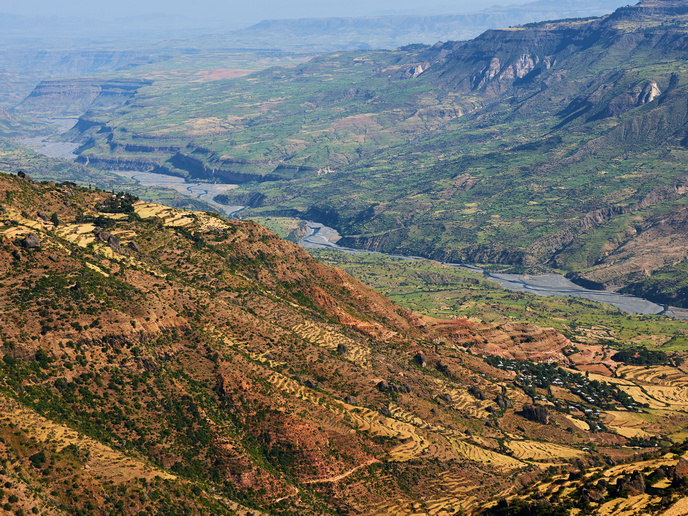
With the support of the European Research Council(opens in new window), Katz was able to investigate this question further. “The RIFT-O-MAT project was built around the mechanical interaction of liquid and solid phases at rift zones,” he explains. These are zones where magma rises towards the surface, leading to geological activity such as volcanic eruptions and hot springs. Katz also wanted to consider ice and water in Earth glaciers, where liquid–solid interactions are similar. Working with postdoctoral researchers Adina Pusok and Yuan Li, as well as PhD student Hanwen Zhang and associate researcher Dave May, Katz developed a sophisticated mathematical and code framework to capture fluid-driven fracture of rock. This was used to model the East African Rift. “Hanwen’s PhD research about liquid–solid mechanics of ice also taught us about how fluid-driven fracture is studied in that community,” says Katz. The team was later joined by Tim Davis, an expert in magmatic dikes. “Tim did outstanding work on understanding how mega-dikes can reach lengths of around 1 000 km without erupting,” adds Katz.
Magmatism and plate tectonics
This groundbreaking work led to a number of fundamental findings. Firstly, modelling showed that magmatism – the process of magma formation and movement – can drastically reduce the force required to rift a tectonic plate. New findings regarding mega-dikes also show that they are not inherently highly pressurised and are able to extend distances of over 1 000 km because they propagate downhill. The project also shone a light on sea-level variations during the Pleistocene era, through its surprising link to mid-ocean ridge fault spacing. Katz says that a manuscript explaining this theory is forthcoming. Overall, the project helped to connect observations of magmatism with observation of plate tectonics. “This helps us to understand why our world has its apparently unique character,” notes Katz. “And if our world – with plate tectonics and an environment fit for life – isn’t unique, then it helps us to envision the conditions that must be met elsewhere.”
Physical oceanography of the basal magma ocean
Katz is currently developing theories to explain the physical oceanography of the basal magma ocean (a layer of molten rock at the very bottom of the mantle) and trying to better understand the macroscopic behaviour of rocks. “I am using ideas from RIFT-O-MAT to study mud volcanoes (that erupt methane-rich muds),” he remarks. “I am also collaborating with Adina, who is now a lecturer at Oxford, on problems associated with the partial melting of Earth’s mantle. It is always fruitful to return to old ideas with new perspectives, so I’ll be back to the RIFT-O-MAT project eventually.”