Learning to speak the right language: how juvenile birds learn what to sing

Juvenile songbirds learn their songs by imitating those of surrounding adults, similarly to how human children learn language. In contrast to humans, songbirds have an extremely limited time under their parents’ care, after which they can be exposed to songs (and other sounds) from other species. A young songbird’s challenge is to discriminate relevant songs coming from their own species, from irrelevant songs. “How they do this is very poorly understood, particularly when they encounter closely related species, which might have tantalisingly similar songs. The ‘mistake’ is imitating the song of other species, which risks failing to find a mate,” explains associate professor in Zoology at Stockholm University(opens in new window), David Wheatcroft, coordinator of the SongNeuroGen project. Some sounds are clearly not relevant and so are not learned, but these differ from species to species. The trick the birds have to learn is to identify the sounds they do need to pick up. An obvious explanation is that songbirds are ‘tuned’ to their own species, in order to prevent them learning the wrong songs, rather as we have difficulty remembering unfamiliar phonemes when learning a new language. “But,” says Wheatcroft, “this has never been tested.” Which is where the European Research Council(opens in new window) supported project stepped in.
Which notes are learned and which ignored? Insights gained from flycatchers
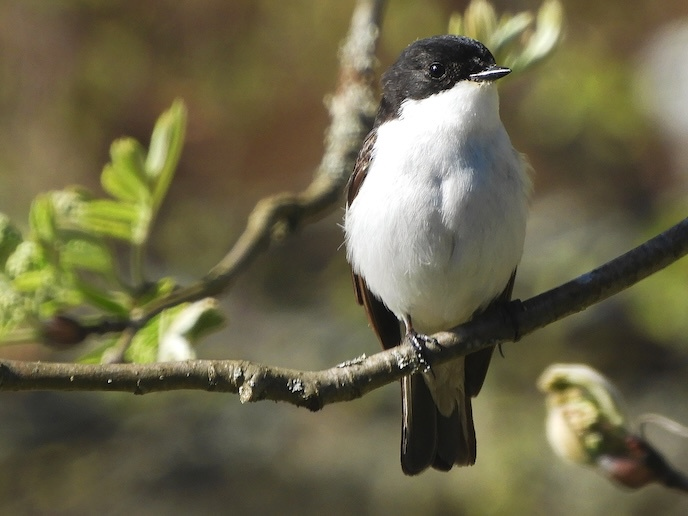
Widely studied across Europe for decades, flycatchers are the perfect subject. By studying them in the wild and in a lab, it is possible to control for possible environmental influences on their behaviour by, for example, experimentally manipulating the songs to which juveniles are exposed. “The two species I study, the collared and the pied flycatcher, co-occur in part of their ranges, where pied flycatchers sometimes imitate collared flycatcher songs. This makes it possible to determine the impact of interactions between species on song learning,” adds Wheatcroft. He had previously shown that nestling pied flycatchers, just 12 days old, prefer to respond to songs from their own species in comparison to songs from a closely related species, the collared flycatcher. One of the aims of the project was to understand how, and why, the preference for species-specific songs has evolved. To do this, Wheatcroft set up a collaboration with five research groups studying pied flycatchers across Europe in locations where collared flycatchers do not occur. Each group determined whether nestlings preferentially respond to songs from their own population, foreign populations or those of collared flycatchers. Another key aim was to determine the relative importance of genes and experience relating to the songs that are produced. The team used two complementary methods. “First, we studied the songs of pied flycatchers that had been translocated as embryos, as fertilised eggs, from the Netherlands to Sweden. Second, we reared pied flycatcher juveniles in captivity and exposed them to songs from their own and foreign populations. “If genes (partially) determine songs, then translocated birds should produce songs that are similar in some ways to their source population and captive birds should preferentially learn songs from their own population,” explains Wheatcroft.
Selective imitation and recognition of songs by nestlings
In the project’s cross-population comparison of song responses(opens in new window) we showed that pied flycatcher nestlings throughout Europe discriminate against the songs of collared flycatchers, even in populations where the two species do not co-occur. This demonstrates that song discrimination does not (at least not primarily) evolve due to the costs of learning the wrong species’ song. In contrast, we showed that nestlings – just 12 days old – can recognise songs that are similar to their own population. The team’s work on the translocated Dutch birds(opens in new window) showed that they imitate Swedish songs, highlighting the fundamental role of experience in song, since they were only exposed to Swedish songs. Wheatcroft notes: “They do, however, selectively imitate those Swedish songs that most clearly resemble Dutch songs, to which they were never exposed. Although we don’t understand the mechanism through which the translocated birds can do this, our work on nestling bird responses showed that pied flycatcher nestlings recognise their own population’s songs from a very early age.” The implication of this finding is that there are genetic differences between the populations that ‘tune’ birds to learn their local songs. “This is remarkable,” says Wheatcroft, “because songs themselves change over time, similarly to human languages.”