Investigating the social determinants of disease risk

As many of us learned during the COVID-19 pandemic, the risk of disease outbreaks can rise among social organisms living in dense groups. Much research has explored the social dynamics of disease spread through an observational lens, but observation alone has limits, notes Yuko Ulrich(opens in new window), principal investigator in the EPIDEMIC project at the Max Planck Institute for Chemical Ecology(opens in new window). “When one individual gets infected, and another doesn’t, is that because of differences in their genes, age, behaviour or social connections? In nature, all of these factors are entangled and very difficult to separate,” she says. Experimental data is lacking however, due to both ethical and logistical challenges. In the EPIDEMIC project, which was funded by the European Research Council(opens in new window), Ulrich and her colleagues turned to ants. The researchers designed a unique system based on the biological characteristics of clonal raider ants, a species with no queens that reproduces without mating. Using automated tracking techniques, the team aimed to detect characteristics that protect social organisms against infectious disease. “I hope our findings can inform how we build predictive epidemiological models, for example, by showing the importance of individual behavioural variation in global disease spread,” remarks Ulrich.
Exploring disease transmission in clonal raider ants
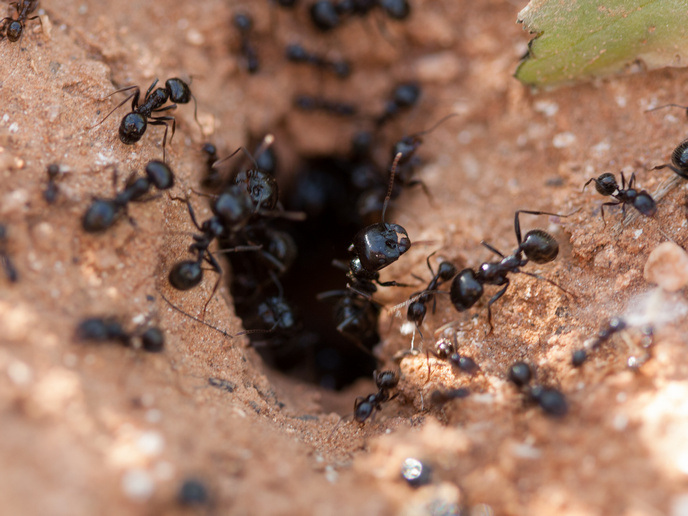
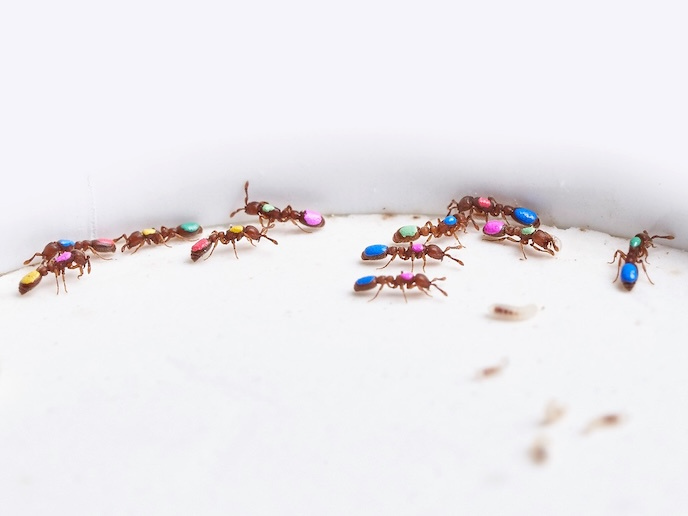
The researchers set up many replicate ant colonies with precisely controlled size and composition. To track behaviour, the team individually paint-marked every ant in each colony with unique colour combinations, then filmed colonies with overhead cameras. Using custom software, they could extract individual trajectories, calculate how much time each ant spent inside and outside the nest, and map the full network of physical contacts – over dozens of colonies simultaneously. For some experiments, the researchers used a naturally occurring nematode parasite, while in others they used immune-stimulating compounds that mimic an infection.
Links between behaviour and infection
The project produced several major findings, including a clear link between behaviour and predicted infection. “Foragers acquired infections earlier and at higher loads than genetically identical nestmates who stayed inside as nurses, confirming that behavioural differences are sufficient to account for the uneven distribution of parasites,” explains Ulrich. Another key finding was that nematode-infected ants decreased their outside activity and spent more time in the nest. More unexpectedly, healthy nestmates did the same, effectively concentrating more individuals together in the nest. “The parasite therefore appeared to reshape the colony’s social organisation in ways that facilitate its own spread,” notes Ulrich. In a separate study, ants that perceived a nestmate as potentially sick in the immune-challenge experiment did not avoid them, but rather increased grooming and physical contact. “This ‘caring’ strategy is predicted to increase rather than decrease transmission risk, which raises interesting questions about when and why colonies might switch between different strategies,” adds Ulrich.
Further explorations of ant behaviour and disease
While the project is over in name, the research is very much continuing in new directions, says Ulrich. Researchers in her lab are investigating the chemical cues ants use to detect disease state in their nestmates, the varied responses ants display in the face of different pathogens, along with other questions raised during the project including the social transfer of protection. “Each of these threads connects back to the same core question that motivated EPIDEMIC: What properties of social groups determine how well they defend against infectious diseases? There remains a great deal to explore,” adds Ulrich.