Synthesising DNA on a chip, using water

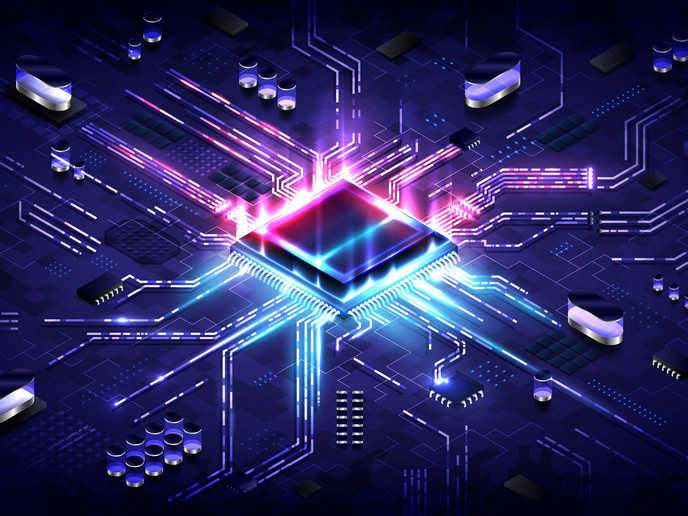
Silicon chips have driven the computing revolution for half a century. Now, thanks to research supported in part by the EU-funded HYPERION project, they are poised to revolutionise how we store information biologically. In a landmark study(opens in new window) published in ‘Nature Electronics’, an international team of researchers has set a new benchmark for enzymatic DNA synthesis. The team successfully wrote 64 distinct DNA sequences in parallel on a single semiconductor chip using a water-based process. This marks a significant leap from the previous limit of just a dozen sequences. The achievement addresses a critical bottleneck in DNA data storage. While traditional phosphoramidite chemistry can produce millions of sequences, it relies on hazardous organic solvents and requires centralised facilities. Enzymatic synthesis offers a cleaner, water-based alternative that mimics nature, but it has historically lacked the scale required for practical data storage. By demonstrating that a chip can orchestrate parallel enzymatic reactions with high precision, the research team has moved the field closer to the capacities needed for commercial viability.
Electrochemical precision in water
HYPERION’s core innovation lies in the chip’s ability to control chemistry at the microscopic level using electric currents. DNA synthesis requires adding nucleotides one by one, a procedure that demands the removal of a temporary blocking group (deprotection) at specific sites before the next addition. The team achieved this by designing electrodes that generate protons to lower the pH locally, triggering the enzymatic reaction only where needed. The chip was originally designed for neuronal recording using precision current injection. “At a certain point, we wondered whether that same current control could be redirected from cells to molecules – replacing the neuron-facing electrodes with ring-electrode pairs that could localise pH for DNA synthesis,” states study senior author and Harvard professor Donhee Ham in a recent news item(opens in new window). “It worked.” This electrochemical patterning allows the chip to grow 64 different sequences in parallel. The team even used these sequences to encode a 169-byte text, illustrating the potential for digital data storage. As co-lead author Woo-Bin Jung notes, “DNA data storage asks DNA synthesis to operate at a scale far beyond today’s needs. … That is why enzymatic synthesis in water can matter. If far more than 64 sequences can be synthesised in parallel, it could offer an environmentally friendly route toward writing DNA at very large scale.”
Chemistry, not electronics, limits scale
In pushing the technology further, the researchers discovered that the current limitation is no longer the silicon chip itself but the chemistry used. When attempting to pack synthesis sites more densely, they found that intermediate molecules generated during deprotection drifted to neighbouring sites, blurring the boundaries. “The chip did what we asked it to do: it localised low pH at selected sites,” comments co-lead author Han Sae Jung. “The limitation came from the deprotection chemistry, not from the silicon. That leaves a clear next step for the field — develop a more direct acid-driven deprotection chemistry that can keep pace with the chip.” The findings provide a clear roadmap for the HYPERION (Proof of concept of affordable and scalable DNA data storage by developing a writing technology based on enzymatic DNA synthesis with a very dense semiconductor integrated circuit (CMOS chip)) project’s ongoing work. Clearing these hurdles will help bring the project a step closer to establishing European leadership in DNA-based data storage. For more information, please see: HYPERION project