



Transforming submarine cables into a European research machine

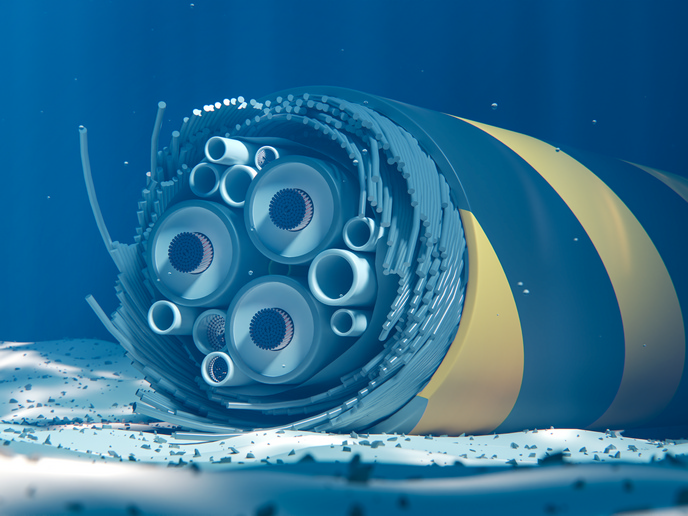
Deep under the surface of the ocean runs a network of telecommunication cables spanning over 1.3 million kilometres. Currently, these optical fibres carry an estimated 95 % of all global internet and voice traffic. But what if they could do even more? That’s the question driving the team behind SUBMERSE(opens in new window), an EU-funded project turning existing underwater cables into a world-class research instrument. “Our aim was to create a new type of remote sensing instrument that can give scientists ready access to data from some of the most difficult-to-reach places on Earth,” says Chris Atherton, senior research engagement manager at GÉANT(opens in new window), one of the project’s partners.
A versatile research infrastructure
To turn this existing submarine telecommunication infrastructure into a research machine, the project retrofitted specialised equipment, so-called fibre-optic interrogators built in Europe by European companies, into existing cable landing-stations. They then attached them to an optical fibre in each included cable, thus effectively turning it into a distributed sensor. “By doing so, we created a versatile research infrastructure capable of continuously collecting data that can support a wide range of scientific and practical uses,” explains Matías Barberis, a researcher at the European Future Innovation System(opens in new window) (EFIS) Centre, the project’s coordinating partner. These uses could include everything from studying geo-risks to providing early warning for tsunamis and other seismic and volcanic events, protecting marine life and even securing the telecommunication cables themselves.
Turning collected data into valuable insights
To support these use cases, the project produced a number of open-source software tools that can use the collected data to, for example, detect and locate whales – information that maritime vessels can then use to help avoid collisions. “By enabling the real-time transmission of data in a minimised format, it can also be easily integrated into established analysis and archival workflows for earthquake analysis,” notes Frederik Tilmann, a professor at project partner GFZ Helmholtz Centre for Geosciences(opens in new window). The project deployed its research infrastructure at eight locations that are near active seismic zones or the migration routes of marine mammals, allowing for the study of marine life, earthquake processes and the oceanographic phenomena.
Building a pan-European research infrastructure
The SUBMERSE project successfully proved that sensors can be installed into the telecom network both securely and in a manner that doesn’t interfere with telecoms traffic. It also showed that data can be distributed via existing European research infrastructures, such as the European Plate Observing System(opens in new window) (EPOS). Building off these achievements, the project team is now working to scale up its research instrument to cover a larger geographic area and to expand the data services on offer, with the Copernicus Marine Service(opens in new window) being targeted for oceanographic products. The project is also exploring how to integrate new fibre-optic sensing technologies into existing cables, potentially opening the door to new areas of research. “Having agreements with at least three European Research Infrastructure Consortia(opens in new window), as well as with GÉANT, to start working on the long-term vision of our project not only puts our research instrument into a league of its own but also places Europe at the forefront of scientific innovation in this field,” concludes Atherton.