


Advances in robot training for the factories of tomorrow

As robots and extended reality (XR) move into the same workplaces, operators need to understand and trust both. Traditional training cannot easily cover hybrid robot–XR scenarios at scale. MASTER was needed to provide an open platform and ready-to-use training content so education and industry can upskill workers for this new reality. This confluence was explored in depth by the MASTER(opens in new window) project, which is aiming to fine-tune the art of robotics training for the factories of tomorrow. This goal is one being explored by a number of EU supported projects. For example, gaze-based interaction reduces the need for complex controllers or menus: the system can understand where the user is looking to select objects or trigger actions in the XR scene, making interaction more natural during training and robot-related tasks. Panagiotis Karagiannis(opens in new window), who coordinated the MASTER project, is based at the Laboratory for Manufacturing Systems and Automation(opens in new window) (LMS) at the University of Patras(opens in new window). He explains: “Industry production models combine automation, robots, sensors and digital systems so factories can produce more flexibly and with closer human–machine collaboration. Instead of rigid, fully fixed lines, people and robots work together and systems share data in real time.” This brings its own challenges. As robots and XR move into the same workplaces, operators need to understand and trust both. Traditional training cannot easily cover hybrid robot–XR scenarios at scale. “MASTER was needed to provide an open platform and ready-to-use training content so education and industry can upskill workers for this new reality,” adds Karagiannis.
Manufacturing will benefit from an open XR platform to train robots
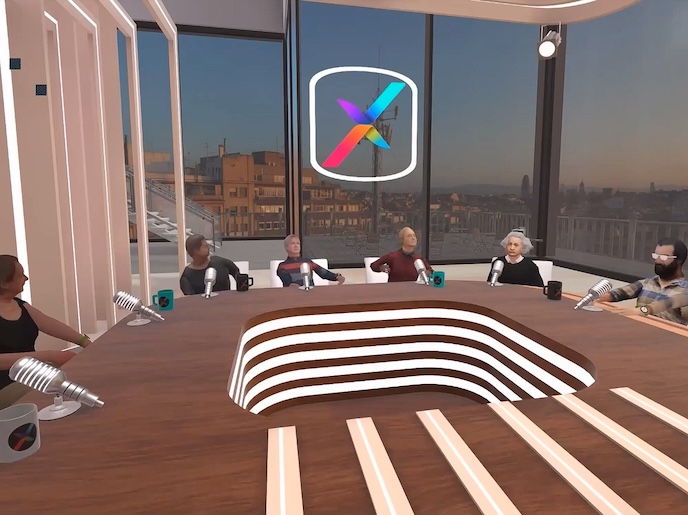
MASTER built an open XR platform for teaching and training robotics in manufacturing, with three main pillars which included safe robotic environments in XR – tools for creating virtual cells where trainees can work with robots without collision or safety risks. The team also worked towards flexible robot programming, including programming by demonstration, so users can program or adapt robot tasks more intuitively, not only through classical code. The final aim was to foster advanced interaction, including gaze-based interaction which aimed at establishing more natural ways to interact with the virtual environment and robots. As Sotiris Makris(opens in new window), associate professor at the Mechanical Engineering and Aeronautics Department and director of the Robotics and Automation Group in LMS says: “In real life, mistakes during training can cause collisions or stoppages. In MASTER, trainees practise in XR first, so they can learn trajectories, safety distances and collaboration patterns before touching the physical robot.” Classical robot programming is often code-heavy and rigid. The project emphasises more flexible approaches, including programming by demonstration, so tasks can be taught and adapted faster in changing production environments. This was combined with XR which made the training and the programming environment part of the same virtual space. The platform has been designed so third parties such as technology providers and training organisations can access training modules, integrate components, and create or test training content. More information can be found on the project website(opens in new window), including a video(opens in new window).
Industrial trials show the benefit of XR training scenarios
The project shared their achievements: selected companies integrated their technologies into the MASTER XR platform and tested them with end users, such as industrial and educational stakeholders. The concepts they covered included areas such as XR training scenarios, interaction mechanisms and tools supporting robotic environments. Feedback was used to refine content and platform features. Beyond the developments of the original consortium, MASTER expanded its ecosystem through two Open Calls, supporting 41 external projects. The first introduced complementary XR technologies, while the second focused on educational applications integrating MASTER resources and selected technologies from the first call. This approach demonstrated how the platform could be extended and reused by external developers, educators and technology providers. “Educators and trainers could use the platform and tools to create their own training material, for example, a module on safe human–robot collaboration or robot programming by demonstration for apprentices and operators,” Karagiannis observes.