A European phenotyping infrastructure to boost plant science and innovation


Understanding how plants grow, adapt and perform in different environments is essential to be able to address some of the most pressing challenges of our time, namely climate resilience, food security, biodiversity and sustainable land use. It is also required for advancing plant-based innovations in areas like biomaterials, functional foods and plant-derived medicines. The European Research Infrastructure for Plant Phenotyping (EMPHASIS) is Europe’s coordinated response to this need. It brings together cutting-edge plant phenotyping capabilities in a single, shared framework accessible to researchers, breeders and innovators across the continent. The EU-funded EMPHASIS-GO(opens in new window) project laid the foundations for EMPHASIS’ long-term sustainability by establishing the legal, financial and organisational framework for future operation as a European Research Infrastructure Consortium (ERIC).
United front on plant phenotyping
Phenotyping involves the measurement of observable plant traits that emerge from interactions between genetic makeup, environmental factors and crop management. It is essential for understanding plant performance. While genetic technologies have advanced rapidly, phenotyping has remained a bottleneck. Without high-quality, large-scale plant phenotyping, much of Europe’s plant genetic potential cannot be translated into resilient, productive crops. EMPHASIS enables access to technologies and expertise that no single institute or country could have on its own. The quality-assured network – already more than 200 advanced plant phenotyping facilities throughout Europe – transforms previously fragmented national capacities into a coherent European infrastructure. According to Susie Robinson of VIB(opens in new window), newly-appointed interim director-general of EMPHASIS: “This shared infrastructure, common standards, and pooled expertise allows us to ask biological questions that were previously out of reach, and to translate phenotyping data into real advances for crop improvement.”
Facilities, protocols, FAIR data stewardship and training
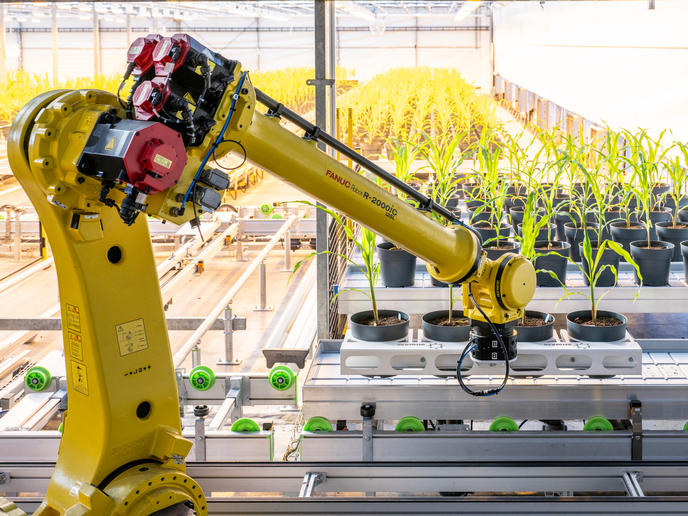
“EMPHASIS operates through four interconnected pillars: on-site and remote access to facilities and services, advanced phenotyping practices with standardised protocols, FAIR (findable, accessible, interoperable and reusable) data stewardship, and education and training,” explains Stijn Dhondt of VIB, outgoing EMPHASIS director. Users can access facilities and services on demand or through EU-funded calls. Strategic coordination in Belgium ensures coherence across Europe. Facilities include high-tech controlled-environment platforms, intensively instrumented field sites, lean field networks, and digital and data platforms. As EMPHASIS programme co-manager Inês Pinho, also of VIB, explains: “Together, they allow plant performance to be studied across multiple scales – from cells to ecosystems, from laboratory conditions to real-world fields and from short experiments to long-term monitoring across multiple environments.” Shared tools, standardised protocols and FAIR data practices improve comparability and reproducibility. Together with innovative training programmes, EMPHASIS is strengthening research quality and skills across the scientific community.
Pioneering research previously impossible to conduct
EMPHASIS-GO built on the success of the previous preparatory phase EU-funded projects, EMPHASIS-PREP and EPPN2020. Through these three projects, hundreds of transnational access projects have enabled researchers, including those from under-represented regions, to use state-of-the-art facilities that would otherwise have been inaccessible. “EMPHASIS-GO has ensured the long-term sustainability of this user-centred, European plant phenotyping infrastructure and positioned it as a leading global hub for plant-based innovation, sustainable agriculture and climate resilience,” adds Enric Belles-Boix of VIB, EMPHASIS programme manager and day-to-day coordinator of the EMPHASIS-GO project. This unified approach is already enabling new types of research and innovation that were previously out of reach, from testing stress-tolerant varieties across climate gradients to combining high-resolution imaging with real-world field performance. Susie Robinson concludes: “By enabling integrated research across environments, locations and countries, EMPHASIS is positioning Europe as a leader in climate-aware plant science, agri-tech and the wider bioeconomy for decades to come.”