Why are stars not spread evenly across the sky?


On a clear night, most people can easily pick out recognisable patterns of stars, from Orion’s Belt or the Plough for example. But why is it that these stars appear clumped together – why are they not spread evenly across the night sky? “There is structure, in the sense that the distribution of stars is not completely random, but to make something completely uniform would be very special,” says Reinout van Weeren, an associate professor at Leiden University(opens in new window). “In a forest for example, trees are not homogeneously spread out.”
A clumpy universe
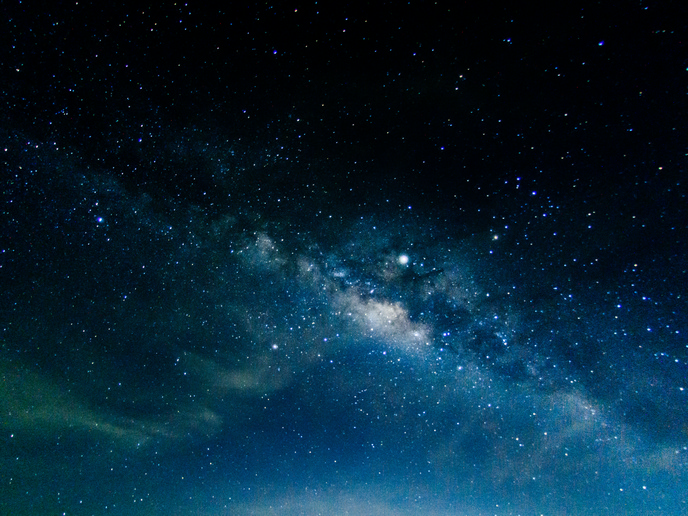
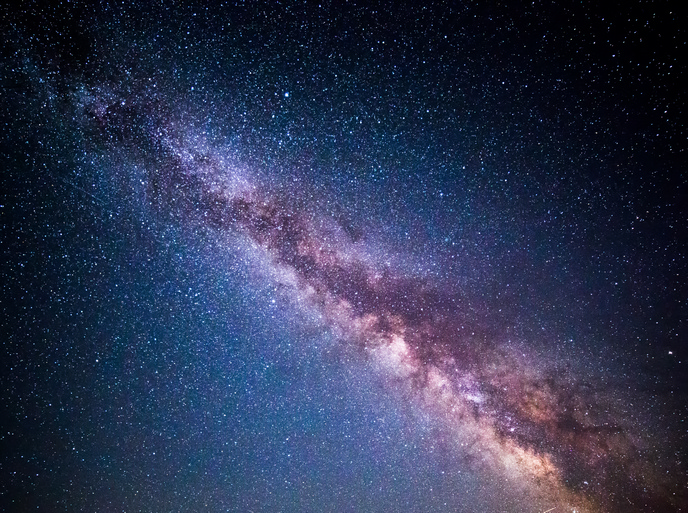
Fundamentally, stars aren’t spread evenly because of gravity. This force pulls together matter into dense clumps, like star clusters and galaxies. As the universe expanded, these galaxies became further and further apart, with great voids opening up between them. This is why we have a ‘clumpy’ universe rather than one in which matter is evenly distributed. “A forest also contains many different types of trees of all sizes,” adds van Weeren. “The same goes for the night sky. Some stars are intrinsically brighter than others, and stars can be either nearby or distant; both factors influence how we observe them.” The position we occupy in the universe also plays a role. We live in a particular galaxy, the Milky Way, which we can think of as a ‘city’ home to some 100 billion stars. We don’t live near the centre though, but rather on the outskirts of town. “If we look in a certain direction, i.e. towards the centre of our galaxy, we see many more stars than we would looking in the other direction,” remarks van Weeren. “If we peer towards the centre, we can even see a band of billions of stars overlapping."
Our spiral Milky Way
Zooming out, we see that our humble star the Sun is located in one of the Milky Way’s spiral arms. “There are two main flavours of galaxy – spiral galaxies like ours, and the more boring elliptical galaxies that look like rugby balls. There are also irregular galaxies that do not fit in these two types,” he explains. “We now think that spiral galaxies formed first and can evolve into elliptical galaxies, which are formed when galaxies merge with each other.” Scientists think that galaxies like ours were formed from collapsing gas clouds, where the interplay between the galaxy’s rotation and gravity gave rise to spiral arms. They also believe that the likely fate of our Milky Way is to collide with the Andromeda galaxy, within the next 10 billion years or so. “This will initially create an enormous burst of star formation,” says van Weeren. “After that though, all the gas will have been used up, and we might end up as an elliptical galaxy with no new stars being born.”
Investigating galaxy clusters
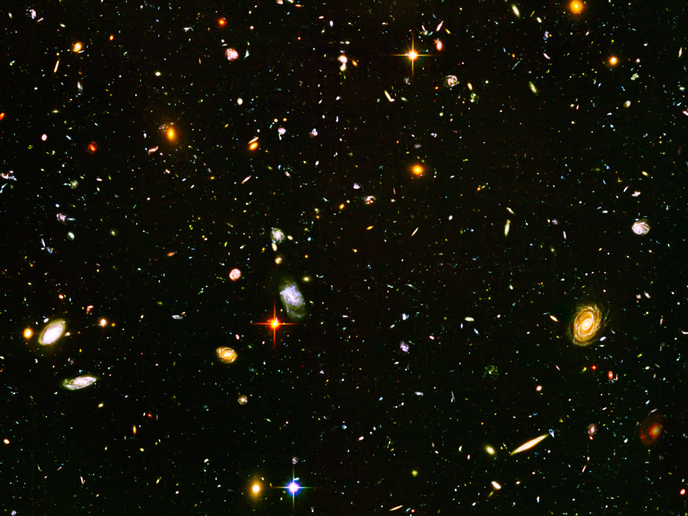
Zooming out even further, we see a similar pattern at a larger scale, with hundreds of thousands of galaxies and gas clouds clustered together. These were the focus of van Weeren’s European Research Council(opens in new window) funded ClusterWeb project. “It turns out that galaxy clusters are almost exclusively comprised of elliptical galaxies,” he adds. “We are now to find out why this is, and what kind of processes are happening in these clusters.” One key area of interest is the influence of hot gas, which strips matter from galaxies as they pass through it. “We are currently investigating this mechanism,” he notes. “This could tell us a great deal about how galaxies evolve, and how they are influenced by their environment.” Find out more about Reinout van Weeren’s research: Shining new light on large cosmic structures