New life for a dead battery

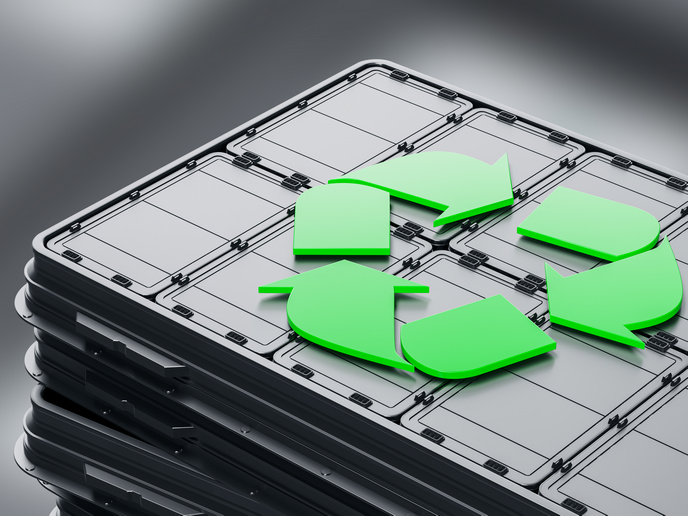
As Europe looks to become the world’s first climate-neutral continent, the European Commission has set the ambitious target of achieving 46 % electrification by 2040(opens in new window). While this clean energy transition will undoubtedly reduce Europe’s carbon emissions as well as its dependence on foreign fossil fuels, it could create new challenges too. “Europe’s electrification will generate increasing volumes of battery waste while simultaneously increasing demand for critical raw materials like lithium, cobalt, nickel and manganese,” explains Angel Manuel Escamilla Pérez, principal researcher at Leitat(opens in new window). Addressing these challenges is BATRAW(opens in new window). Coordinated by Leitat, the EU-funded project brings together partners from across Europe(opens in new window) to develop a sustainable and circular value chain for end-of-life lithium ion batteries such as those used in electric vehicles (EVs).
Solutions cover the entire battery life cycle
The BATRAW approach covers the entire battery life cycle – including the dismantling of used batteries. For example, the project developed a semi-automated battery disassembly line that uses robotics, artificial intelligence-based vision systems and laser cutting technologies to safely and efficiently dismantle EV battery packs. During pilot demonstrations, the line reduced dismantling times by 50-60 %, optimised manual operations and improved worker safety. The project also developed advanced hydrometallurgical recycling technologies for recovering critical raw materials. During a pilot-scale demonstration, the solution posted recovery rates exceeding 98 % under industrially relevant conditions. “By integrating these two pilot plants, we reduced dismantling times, improved safety and, at the end of the hydrometallurgical process, delivered high-quality recovered materials that can now be used to produce new cathode and anode materials,” says Escamilla. To support the reuse of the recovered material, researchers also evaluated second-life applications for batteries, including an 80 kWh second-life energy storage system and a related rapid state-of-health assessment tool.
A digital battery passport
In addition to its recovery and recycling technologies, the project helped implement a digital battery passport and a blockchain-based traceability platform. “By tracking batteries and battery materials at all stages, our passport, together with the traceability platform, helps identify weaknesses in the value chain while also making it easier for recyclers to extract critical raw materials and drive the circular economy,” adds Escamilla. As of 2027, the European Commission will require a digital battery passport for all EV batteries with a capacity greater than 2 kWh placed on the EU market.
Towards a circular, sustainable battery ecosystem
By integrating the entire battery value chain – from battery collection and diagnostics to dismantling, recycling, material recovery, manufacturing new battery materials and digital traceability – the BATRAW project has reduced Europe’s dependence on imported materials, lowered the environmental impact associated with mining, reduced waste and strengthened European resource security. “BATRAW showed that a circular and sustainable European battery ecosystem is technically feasible, economically plausible and environmentally beneficial,” concludes Escamilla. The project team is now focused on scaling up its most promising technologies, with the goal of moving them towards commercialisation and industrial deployment.