



Living cement gives sustainable construction a solid footing

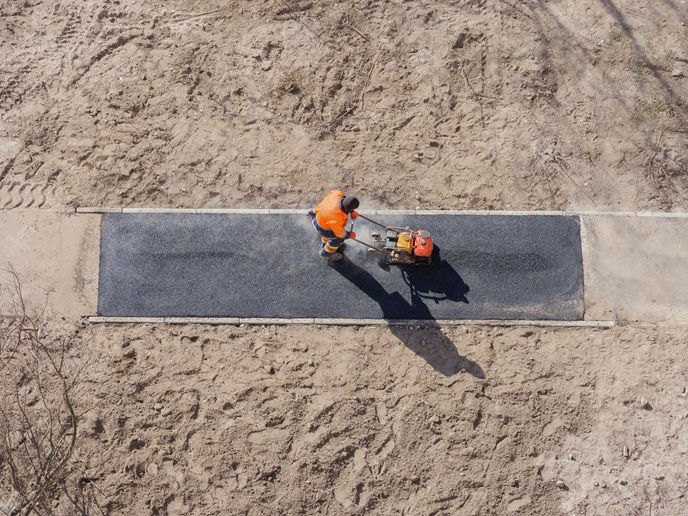
Urbanisation, ageing infrastructure and the increasing frequency of hazards such as earthquakes, soil erosion and landslides are driving the growing need for ground stabilisation services. This typically involves improving the durability and water resistance of unstable soils by adding chemical binders, or using heavy machinery to compact the soil. These solutions are far from ideal. Huge amounts of energy are also required on-site to generate the high pressures required to inject stabilising agents into the ground. Furthermore, existing fly ash-, lime- and cement-based solutions can cause irreversible damage to groundwater and subsurface ecosystems.
Environmentally friendly infrastructure repairs
The CEBREWA(opens in new window) project, supported by the European Research Council(opens in new window) (ERC), sought to address a key industrial need – market-ready, innovative bio-based ground stabilisation solutions that are effective and less environmentally disruptive. The project built on breakthrough developments achieved in another ERC-funded project called BIOGEOS, which patented novel biocementation technologies for civil, geotechnical and geo-environmental works. Instead of chemical agents, these solutions use microorganisms to solidify loose soils and repair construction materials. “What we do is harness bio-mediated calcite formation to allow soils to create their own mineral bonds, instead of relying on conventional synthetic binders,” explains CEBREWA project coordinator Lyesse Laloui, director of the Soil Mechanics Laboratory(opens in new window) at the Swiss Federal Institute of Technology Lausanne (EPFL). The process injects selected microorganisms (or their enzymes) into the soil, where they produce calcium carbonate through their metabolic activity. These crystals of limestone act as a biological cement, binding the surrounding material. CEBREWA sought to demonstrate the validity of this technology and accelerate the commercialisation of industry-ready solutions. “We evaluated the technology from the pore scale to the field scale,” says Laloui. “For this we used advanced imaging, laboratory testing and numerical modelling. We also used large-scale bioreactors to produce microorganisms and carried out full-scale slope stabilisation trials.”
Treatment efficiencies and strength improvements
The 18-month project successfully demonstrated that biocementation can be scaled from laboratory studies to engineering-relevant applications. What’s more, the field trials revealed that treatment efficiencies and significant strength improvements can be achieved. “The project also delivered design and monitoring tools that support the deployment of this technology in applications such as erosion control, bearing-capacity improvement, slope stabilisation and road reinforcement,” adds Laloui. Next steps include accelerating industrial deployment through additional field validation, international certification (ISO, CE) standardisation and quality-control procedures. “The technology is already being transferred through patents and the EPFL spin-off Medusoil(opens in new window),” notes Laloui. “Ongoing work focuses on scaling production systems, expanding applications and integrating biocementation into mainstream geotechnical practices.”
Market-ready biotech ground stabilisation
Laloui and his team believe that the market for this biotech ground stabilisation solution is only set to grow. Extreme weather events are likely to accelerate the need for repairs to roads, railroads, embankments, reservoirs and dams. The increasing scarcity of suitable land for development and the need to extend existing infrastructure to support increasing populations in urban zones, also call for more ground stabilisation. “Our ambition is to make ground improvement significantly lower-carbon, less invasive and more environmentally compatible without compromising engineering performance,” concludes Laloui. “Infrastructure owners, contractors, public agencies and communities exposed to geohazards stand to benefit from a new generation of sustainable ground stabilisation technologies.”