
Counting male chicks with light before eggs hatch

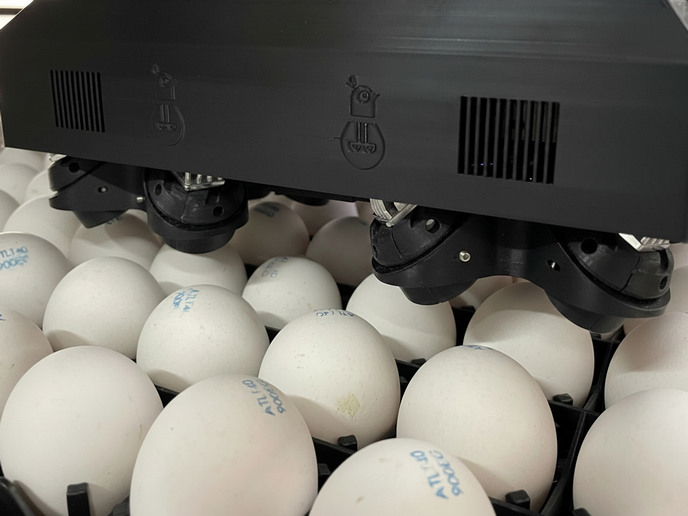
An estimated 330 million(opens in new window) male chicks are killed in the EU every year because they neither lay eggs nor produce enough meat to be profitable. This practice not only raises ethical concerns but also results in significant waste for the poultry sector. Several Member States have called for an EU-ban on this procedure, which is already prohibited in Germany and France. Current methods for sexing chicks, however, are invasive, inefficient and costly. The EIC-funded Omegga(opens in new window) project is addressing this challenge by developing machine learning-based spectroscopy(opens in new window) technology that can detect a chick embryo’s sex within the egg. This knowledge allows hatcheries to remove male eggs from incubators, thereby only hatching female chicks.
A light-based non-invasive technology
The system can determine the sex of an embryo while still inside the egg by day six of incubation - well before the development of any pain perception. This allows male and non-viable eggs to be removed early and repurposed for uses such as vaccine production and animal feed, thereby completely avoiding the need for culling. “The eggs are screened using light and the emitted spectrum measured,” says Omegga CEO Katharina Hesseler. “These measurements are repeated over several days and analysed using AI to identify subtle sex-specific changes in the egg, including gender-specific developments in the embryo.” The technology is designed as a plug-and-play module that can be retrofitted into standard industrial incubators. This allows hatcheries of all sizes to adopt it without having to rebuild existing infrastructure. By integrating directly into existing hatchery infrastructure, the technology ensures minimal disruption, offering a cost-effective, scalable and regulation-compliant solution.
Humane and sustainable
Unlike other methods that require puncturing the eggshell, Omegga’s approach is purely optical, preserving hatchability rates and reducing contamination risks. Non-invasive classification is important since it doesn’t harm embryo development, is more scalable and requires less human involvement. According to Hesseler: “Nothing is cheaper than light, which is affordable, fast and precise. Furthermore, it’s non-invasive and purely optical, meaning no chemicals or needles are required and no additional personnel.” The expected project impact is substantial: “We aim to eliminate the culling of up to 100 million male chicks annually,” Hesseler points out. “This aligns with the EU’s strategic goals to improve animal welfare, promote sustainable agricultural innovation and support a circular economy in food production. Our ultimate objective is to make culling-free egg production the global standard.”
Multiple applications across industries
The biggest scientific challenge researchers faced was in obtaining a reliable signal through an intact shell, especially during the first days of embryo development. This was achieved despite natural variation in egg size, shape, colour and shell thickness. “We overcame this with our time-series approach,” explains Hesseler. “By comparing each egg against its own earlier measurements, we can reduce biological noise and amplify the sex-specific signal.” The technology is highly versatile and can be adapted to many industries where fast, automated, in-line analysis is valuable. “This approach can be extended beyond the poultry industry, with possible uses in agriculture, food production and industrial quality control. By building on the same core platform, we can expand into new markets over time, creating a scalable business with opportunities for significant long-term growth potential,” Hesseler concludes.