Putting a stop to fishing’s ghost gear problem

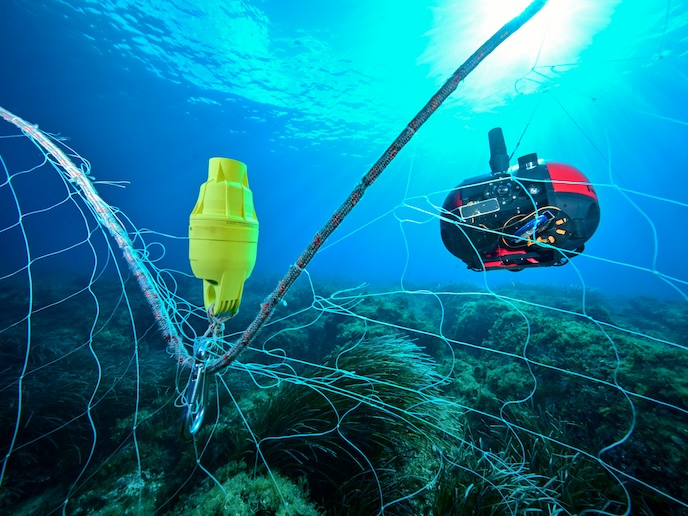
Accounting for an estimated 10 % of all marine litter, abandoned, lost or otherwise discarded fishing gear (ALDFG) is a pressing yet often overlooked environmental challenge. “This ‘ghost gear’ not only poses a direct threat to Europe’s marine life, it can also disrupt maritime navigation and thus have a socio-economic impact too,” says Sandra Ramos(opens in new window), a biologist at the University of Porto’s Interdisciplinary Centre of Marine and Environmental Research(opens in new window) (CIIMAR). Through the EU-funded NETTAG+[DB1.1](opens in new window) project, CIIMAR is leading a consortium of partners(opens in new window) dedicated to helping the fishing industry reduce its environmental impact. “Our goal is to develop and demonstrate complementary and innovative solutions that can prevent, avoid and mitigate the harmful impacts of fishing gear and marine litter derived from fisheries,” adds Ramos, who serves as the project coordinator.
Recognising and rewarding the guardians of the ocean
To prevent ALDFG from happening in the first place, the project worked to position professional fishers as ‘guardians and cleansers of the ocean’. Via workshops, events, virtual reality and information campaigns, the project raised awareness about best practices in litter management. These actions were reinforced by a handbook of best practices(opens in new window) that was co-designed with fishers and designed to help them separate and store marine litter collected during routine fishing operations. The project’s findings also fed into a white paper entitled: Fishers’ Reward Programmes for Marine Litter Collection. “This paper provides insights to inform the design of scalable, policy-aligned reward schemes that recognise fishers for bringing marine litter to fishing ports where it can enter the circular economy,” notes Ramos.
A new way to rapidly locate and recover lost fishing gear
In terms of avoiding the unintentional loss of fishing gear, the project developed MyGearTag. The market-ready, affordable and easy-to-use acoustic gear location system helps fishers rapidly locate and recover fishing gear before it becomes ghost gear. “MyGearTag enables fishers to rapidly locate and recover lost fishing gear at distances exceeding 2 km and depths greater than 650 m, reducing gear replacement costs, recovery efforts, search time and the environmental impacts associated with ALDFG,” explains Ramos. The solution was successfully demonstrated in Croatia, Italy, Portugal, Spain and the United Kingdom across different fishing gear types, and is already being commercialised by project partner Succorfish(opens in new window).
Detect, map and track abandoned, lost and discarded fishing gear
Through its mitigation solutions, the project also targeted ALDFG already present in the ocean. The innovative system combines high-resolution sonar image systems and artificial intelligence processing algorithms with autonomous robotic platforms to detect, map and track ghost gear. “The idea is that the system will eventually support large-scale ALDFG monitoring and recovery operations,” remarks Ramos. The project further advanced technologies to reduce interactions between fishing activities and marine megafauna, including an acoustically activated release mechanism to support ropeless fishing and a real-time cetacean detection system.
Leading the way in restoring our oceans and waters
NETTAG+ has delivered a portfolio of complementary social, policy and technological solutions uniquely designed to prevent marine litter derived from fisheries, avoid fishing gear loss and mitigate the impact of ALDFG. “By increasing awareness of marine litter, encouraging the adoption of best practices and providing innovative tools to prevent, avoid and mitigate ALDFG, fishers and fisheries are now positioned to play a leading role in restoring our oceans and waters(opens in new window),” concludes Ramos.