Can dogs really tell how we’re feeling?

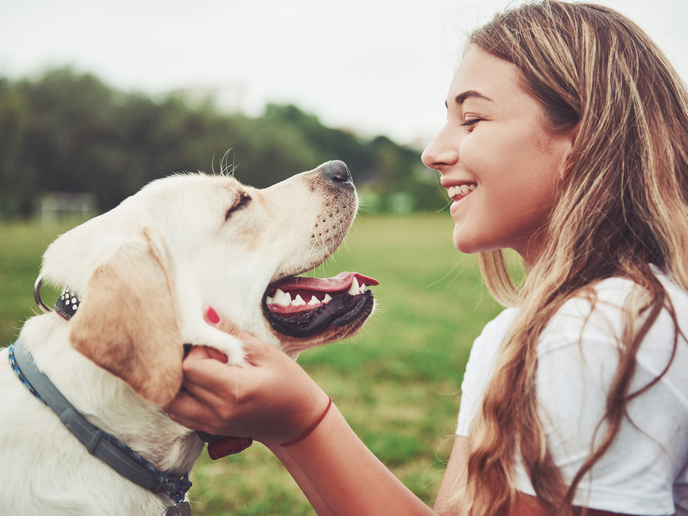
Anyone who shares their life with a dog already knows how easily our four-legged friends pick up on if we’re feeling happy or upset. These canine companions share our every emotional high and low. They leap for excitement at the mere mention of a walk, or gently check in when we’re feeling blue. In a first, a research team from Austria, Hungary and Mexico examined what’s going on inside dogs’ brains to uncover if human’s best friend has the ability to distinguish emotions in people’s faces. The researchers used machine learning to examine the brain activity of 12 pet dogs while the animals looked at pictures of human faces showing joy, anger, fear and sadness.
Decoding canine thoughts
Researchers found that the parts of the brain responsible for processing rewards and complex thoughts – temporal cortex and caudate nucleus – responded solely to pictures of happy people. Anger, fear and sadness failed to spark any reaction in those same regions of the brain. But when looking at the brain as a whole, the team of researchers spotted unique patterns that set fear apart from anger and sadness. “As far as we know, it’s the first time there is proof that dogs can distinguish between faces expressing two [similar] emotions,” senior author Laura Cuaya, postdoctoral researcher from the University of Vienna, told ‘The Washington Post’(opens in new window). The findings were published in the journal ‘iScience’(opens in new window). “Humans are really good at picking up small details on the face, so are dogs,” commented first author Raúl Hernández-Pérez, also from the University of Vienna, on ‘CNN’(opens in new window). “This makes dogs very interesting. By studying their brains, we can understand what adaptations have developed to support their remarkable social and emotional understanding of humans.” He added: “By reflecting on how remarkably attentive dogs are to our emotions, we can also try to become better at recognising how they express their own. Emotions are a powerful form of communication that can connect us across species.”
Connecting with companions
To date, scientists have focused on comparing humans with primates, such as chimpanzees – our closest living relatives. “With dogs, the story is totally different. They followed a very different evolutionary path, but through domestication, they developed the social abilities needed to understand and cooperate with us,” Cuaya explained to ‘The BBC’(opens in new window). The study should help owners better understand and connect with their furry companions. “We can reward our dogs with treats, but also reward them with happiness. So we should smile at the dogs - even at random dogs in the street,” stated Cuaya. Moving forward, the researchers plan to view the world from a dog’s perspective. Their goal is to understand how dogs piece together these various cues to figure out the people in their lives. They also want to compare human and dog brains to see how each handles the same emotional cues.