Orbital processing helps small satellites deliver big data


As the number of satellites orbiting and observing our planet continues to grow, so too does the amount of data they generate. Getting this data back to the ground, however, is a challenge. The downlink from satellite to Earth acts as a bottleneck, due to limitations in radio frequency bandwidth. There are a limited number of ground stations available to receive data, and where they do exist, they are only able to connect with satellites as they pass overhead. Cost is also a major issue, as installing a new ground station is prohibitively expensive for small-satellite missions, throttling the growth of the space services ecosystem.
Shrinking files, expanding coverage
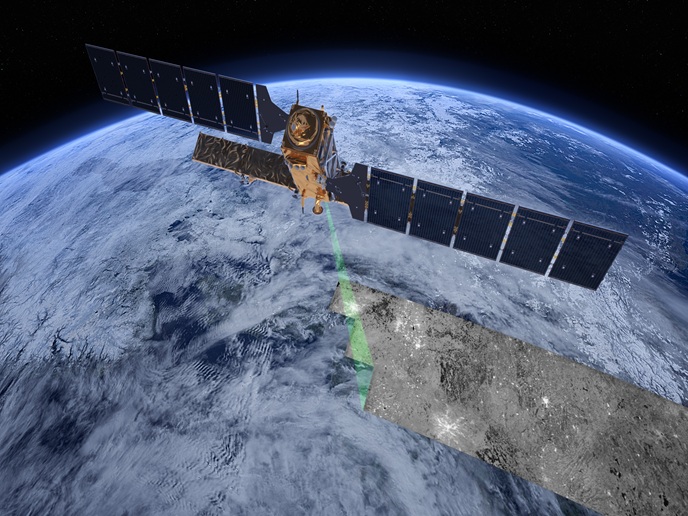
One solution is to reduce the amount of data to download. “The idea behind SOPHOS is to enable more processing directly in space,” explains Maike Taddiken, project manager at DSI Aerospace(opens in new window) and SOPHOS project coordinator. Through SOPHOS, a consortium of European industrial and academic partners led by DSI Aerospace designed and developed new technologies that perform data compression and image formation on board satellites, using a high-performance processing module, optimised algorithms and reliable data storage. “The system reduces the transmission data volume, making far more efficient use of the limited downlink capacity,” adds Taddiken. This is especially valuable for data-intensive applications such as synthetic aperture radar (SAR), a high-resolution Earth observation (EO) technique that can generate massive amounts of raw data. By miniaturising high-performance hardware modules and optimising SAR processing algorithms for use on satellites (where computing and battery power may be tightly constrained), the technology relieves some of the downlink capacity pressure. This allows the most pertinent data to be delivered in less time. “This is particularly relevant for the growing commercial small-satellite sector, as well as for applications such as damage assessment and disaster response coordination,” notes Taddiken.
Launching new hardware and software
The hardware and software advances developed by SOPHOS were tested in a ground-based demonstrator built by the project. For hardware, SOPHOS focused on two key satellite modules. The Payload Processing Module (PPM) was worked on by partner Unibap(opens in new window), and a newly developed radiation-tolerant Mass Memory Module (MMM) was developed by DSI Aerospace. High-speed Ethernet routing allows images and data to be processed online or offline, or replayed raw to the ground segment. Taddiken says that both modules were developed to fit SmallSat form factors, a type of satellite that is increasingly popular for commercial missions and constellations. In supporting work, SOPHOS consortium partners DLR Microwaves and Radar Institute(opens in new window) also developed new algorithms for SAR image formation and raw data compression, which were further optimised to increase the performance and data throughput for the system by researchers at the University of Lübeck(opens in new window) in Germany. SOPHOS partner TELETEL in Greece developed easily deployable Electrical Ground Support Equipment(opens in new window) (EGSE) used for prelaunch operations.
Boosting Europe’s capabilities in Earth observation
By increasing the bandwidth of our connections to orbital observatories, SOPHOS aims to strengthen Europe’s competitiveness in space-based EO. The project’s off-the-shelf technology offers a scalable solution that could be adapted for future low Earth orbit missions. The project, which concluded in early 2026, is already making an impact. “SOPHOS technologies are already in orbit on several missions, while development will continue on the project’s outcomes by the partners, both individually and in different collaborations,” says Taddiken.