Turning livestock manure into market-ready fertilisers

European agriculture faces pressure from supply disruptions and price volatility of fertilisers due to dependence on imported mineral or fossil-based fertilisers and scarce resources. At the same time, excess livestock manure compounds the problem through pollution and nutrient imbalances. The EU-funded FERTIMANURE(opens in new window) project set out to reconnect the nutrient flow between livestock waste and crop production. Through innovative technologies and viable business models, FERTIMANURE created high-value fertilisers capable of competing in the EU fertiliser market to support a circular bioeconomy.
Nutrient recovery and BBFs across European farms
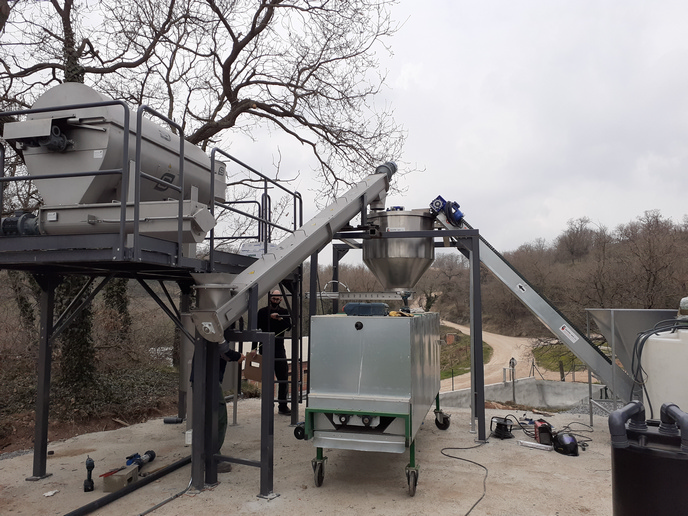
Five on-farm experimental pilots across Belgium, Germany, Spain, France and the Netherlands tested different but complementary technological schemes. All recovered commercially relevant amounts of nitrogen, phosphorous and potassium in BBFs. “The Dutch pilot recovered 100 % of all nutrients in four BBFs. Demonstrating a profitable sustainable business case, it transitioned into a permanent, fully operational installation celebrated in Dutch media,” notes project coordinator Laia Llenas Argelaguet of the www.betatechcenter.com (BETA Technological Centre), University of Vic - Central University of Catalonia.
Market-ready products with regulatory and safety compliance
The pilots produced BBFs and tailor-made fertilisers (TMFs) using three strategies: on-farm direct production of BBFs from manure, on-farm BBF production followed by TMF production for crop-specific needs at a central facility and on-farm TMF production. The project identified and characterised 18 BBFs with commercial potential, exceeding its goal of 11. Six are fully compliant with the strict standards of the EU Fertilising Products Regulation 2019/1009, another six require a simple sanitation step to achieve full compliance, while the rest require further development. “To ensure the TMFs were formulated for specific crop needs, FERTIMANURE developed the TMF nutrition tool not originally foreseen. Using the tool, we successfully formulated 44 TMFs for 44 soil-crop combinations and produced 20,” Llenas Argelaguet explains. Field and pot trials from 2021 to 2023 confirmed the high potential of BBFs and TMFs to reduce dependence on conventional fertilisers.
Tools and tailored information for the entire value chain
The FERTIMANURE project went beyond the initial grant agreement to ensure the project’s scientific findings would have real, measurable impact. “We recognised that to solve the ‘manure challenge,’ we needed to provide more than just data, so we developed actionable tools and tailored information for our diverse stakeholders,” says Llenas Argelaguet. The FERTIMANURE management package(opens in new window) of downloadable tools includes the TMF nutrition tool, regulatory and business tools, and a decision support system. “Our eight detailed business plans for different fertiliser types together with the dedicated regulatory and business tools will help stakeholders navigate legal hurdles and assess economic feasibility,” Llenas Argelaguet notes. Therefore, ‘one-pagers’(opens in new window) on each BBF, alongside three dossiers on the most promising for organic farming will support both farmers and researchers. Three position papers – two in collaboration with sister projects – guide policymakers. Beyond Europe, FERTIMANURE organised face-to-face exchanges and online events with the Community of Latin American and Caribbean States (CELAC). These led to a roadmap to reduced dependency on mineral fertilisers and formal adaptation of the FERTIMANURE approach to local conditions by countries in the region. Argentina is a stand-out case. Argentina’s National Institute of Agricultural Technology (INTA), a FERTIMANURE partner, is responsible for assessing the Argentinian regulatory framework for fertilisers, harmonising bio-based alternatives with regional and EU standards. Within this context, the FERTIMANURE approach was a natural fit. “We encourage the research community to look beyond the lab and prioritise the creation of diverse dissemination materials that empower farmers, industry and policymakers to adopt circular solutions. This holistic approach ensures that research results solve real-world challenges like the manure management crisis,” concludes Llenas Argelaguet.