Supporting East African smallholder farmers

Although East African smallholder farmers typically cultivate plots smaller than two hectares in size, they produce up to 70 % of their country’s food(opens in new window). Yet despite their critical role, these farmers face many challenges, including climate change, resource scarcity and limited economic opportunities – challenges that could jeopardise the entire region’s food security. Navigating these challenges requires a transformation of Africa’s agriculture sector. Helping to steer that transformation is agroecology. “Agroecology means productive, sustainable, resilient and environmentally safe farming and food systems that combine indigenous knowledge with cutting-edge science,” explains Jan Hoinkis, a researcher at the Karlsruhe University of Applied Sciences(opens in new window). “It aims to optimise interactions between plants, animals, humans and the environment while also promoting fair, just and sovereign food systems.” With the support of the EU-funded PrAEctiCe(opens in new window) project, Hoinkis is coordinating a group of researchers, farmers, advisors, civil society actors, small to medium-sized enterprises and public stakeholders from across Europe and Africa. Together, the group is working to guide smallholder farmers in East Africa through their agroecological transition. “Our goal is to move agroecology from a broad concept towards an operational, evidence-based decision framework that can support real farm-level choices,” adds Hoinkis.
Translating agroecological concepts into targeted on-farm metrics
At the heart of the project is a new indicator framework that focuses on circular water-energy-nutrient systems in integrated aqua-agriculture. “This is unique as these are areas that had not been sufficiently captured in existing agroecology indicator frameworks,” says Hoinkis. Developed as an actionable decision support tool for advisors(opens in new window), the framework translates complex agroecological concepts into targeted, on-farm metrics. Amongst the platform’s core components is an integrated indicator for assessing circular farming approaches, with an emphasis on the synergistic reuse of water, energy and nutrients within diversified crop, livestock and aquatic systems. It also includes an impact quantification tool for measuring environmental impacts, resource efficiency and financial viability.
Putting farmers at the centre of its work
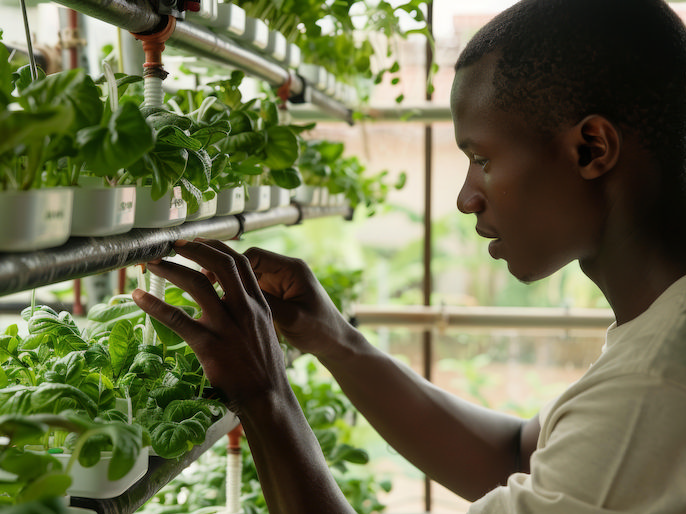
Piloted in three East African countries via Living Labs(opens in new window), the project has conducted 10 training sessions in Kenya, training over 800 farmers in fisheries management and vegetable production. Small agro-companies have now taken up this training. In Kajjansi, Uganda, the project engaged more than 250 stakeholders and trained them in aquaponic food production with a train-the-trainer programme replicated at the training lab. Last but not least, the Tanzania Living Lab trained 5 000 people, focusing on poultry, fish and crop farming systems.
Expanding the agroecological transition in the years to come
Another key result of the project is the mobilisation of a strong multi-actor network across Europe and Africa. “This network itself is an important outcome because the agroecological transition requires more than technical solutions – it requires trust, local knowledge, training and institutional uptake too,” remarks Hoinkis. This network will continue to advance the project’s work and benefits in the years to come. “I’m confident that we will continue to expand on PrAEctiCe’s legacy of making the agroecological transition more measurable, practical and locally grounded for East African smallholder farming,” concludes Hoinkis. Researchers are now working to move the project’s tools towards scaling, refinement and exploitation, as well as growing the Living Labs into local innovation hubs.