Discover how EU-funded research is making aquaculture more productive and sustainable


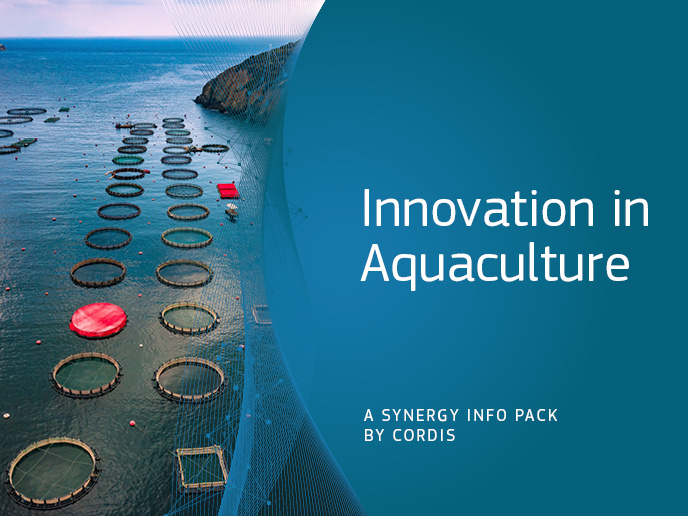
While global aquaculture production has increased 54 % over the past decade, production in the EU has declined, leaving the Member States reliant on imported fish and shellfish. What Europe needs are new ways to increase aquaculture production. But this growth cannot come at the expense of its ambitious climate goals. By supporting research and innovation projects that deliver new technologies, training, regulation and value chain enhancements, EU funding programmes such as Horizon Europe, the European Maritime, Fisheries and Aquaculture Fund (EMFAF) and the LIFE programmes are working collaboratively to secure the EU’s strategic aims for a sustainable, scalable and resilient aquaculture sector.
Sustainable finfish production
The Synergy Info Pack on aquaculture innovation opens by showcasing the work being done to make finfish production more sustainable. This work includes finding new ways to prevent fish disease by developing bio-based alternatives to antibiotics, for a healthier and more resilient approach to carp, trout and salmon production. Sustainable production also requires finding sustainable ways to feed farmed fish, which is exactly what several projects aim to do with their fungi- and insect-based fish feeds. Chapter 1 also looks at how research and innovation are developing the digital solutions needed to increase the production of organic aquaculture in Europe.
Algae innovation on land and sea
Another area of aquaculture that benefits from EU-funded research is algae production. With the support of EU funding, a 40 000 m² floating seaweed farm capable of producing 300 dry tonnes of biomass per year is under construction. This is complemented by successful efforts to identify new ways and places to grow algae, including algae farms that integrate into offshore wind turbine arrays, as well as using regenerative ocean farming as a model for the large-scale production of seaweed. The chapter further highlights efforts to streamline the algae production chain, with two projects building platforms where stakeholders can coordinate and share resources.
Circular economy and zero-waste aquaculture
By turning aquaculture into a circular, zero-waste industry, EU-funded research is working to put the sector at the heart of the Green Deal. This is achieved through efforts to turn aquaculture waste into new, value-added products for the energy, agriculture, cosmetic and construction sectors. It also involves addressing the industry’s plastic use through the development of biodegradable nets and ropes, as well as models for how both algae and fish production can work in concert with urban wastewater processing in cities.
Supporting the aquaculture transition
Although all the innovative solutions highlighted are creating a more sustainable and competitive aquaculture sector, building true resiliency also requires skills, coordination and climate adaptation. Here too EU-funded research delivers. The publication shows how projects are leveraging big data and artificial intelligence to support Europe’s aquaculture-rich regions in adapting to climate change. It also highlights EU tools designed to help the aquaculture value chain better coordinate – both with each other and with related sectors. Last but not least, it looks at how one project is using serious gaming and online platforms to train the next generation of aquaculture professionals. The 26 projects featured in the Pack reflect the diversity of research interests and objectives supported through Horizon Europe, the European Maritime, Fisheries and Aquaculture Fund (EMFAF) and the LIFE programmes. These mutually supportive actions reinforce Europe’s research and innovation efforts, accelerating progress towards a competitive, climate-neutral and resilient aquaculture sector and towards Europe’s social, economic and environmental goals. Download and read the Synergy Info Pack on innovation in aquaculture(opens in new window)
About Synergy Info Packs
Published by CORDIS, Synergy Info Packs highlight the synergies between projects delivered under various EU funding programmes. Projects in this Pack were funded through Horizon Europe(opens in new window), the European Maritime and Fisheries Fund(opens in new window) (EMFF) and its successor the European Maritime, Fisheries and Aquaculture Fund(opens in new window) (EMFAF), and the LIFE programmes(opens in new window). The Horizon Europe projects featured in this Synergy Info Pack are managed by the Directorate General for Research and Innovation(opens in new window) (DG RTD) of the European Commission. Responsible for EU policy on research, science and innovation, it develops and implements EU research and innovation policy, supports EU priorities such as green and digital transitions, and coordinates EU Missions and research partnerships. The remaining projects are managed by CINEA(opens in new window), the European Climate, Infrastructure and Environment Executive Agency. Established by the European Commission under the motto ‘Funding a Green Future for Europe’, CINEA contributes to the European Green Deal(opens in new window) by implementing parts of EU funding programmes for transport, energy, climate action, environment, and maritime fisheries and aquaculture.
Keywords
- synergy
- pack
- innovation
- research
- aquaculture
- sustainable
- finfish
- fish
- shellfish
- algae
- aquafeed
- regenerative ocean farming
- circular economy
- zero waste
- Green Deal
- data
- artificial intelligence
- climate change
- Horizon Europe
- European Maritime and Fisheries Fund (EMFF)
- European Maritime
- Fisheries and Aquaculture Fund (EMFAF)
- LIFE programmes