Extracting a much-needed resource from a widely accessible waste stream

Sewage – a never-ending supply of waste with various potential applications, some of which are being exploited and others under development. Extracting the phosphorus present in sewage is a significant area of interest. White phosphorus is widely used by several industries, ending up in different products from pharmaceutical application in medication, as a flame retardant, or in the production of batteries for the automotive industry for example. High-quality phosphoric acid, produced from white phosphorus, is also used during the manufacturing of semiconductors or in the food industry as an acidity regulator for soda drinks. So, there is keen interest in coming up with innovative approaches to the extraction of the element. “Assuming growing sludge amounts in Europe, and that the EU continues its commitment to phosphorous recovery, by 2050 FlashPhos(opens in new window) would be able to recycle 1.5 million tonnes of sewage sludge dry matter a year,” explains FlashPhos coordinator Christian Schmidberger(opens in new window) based at the University of Stuttgart(opens in new window) in the department of Decentralized Energy Conversion(opens in new window).
Three-step process to extract phosphorus from sewage
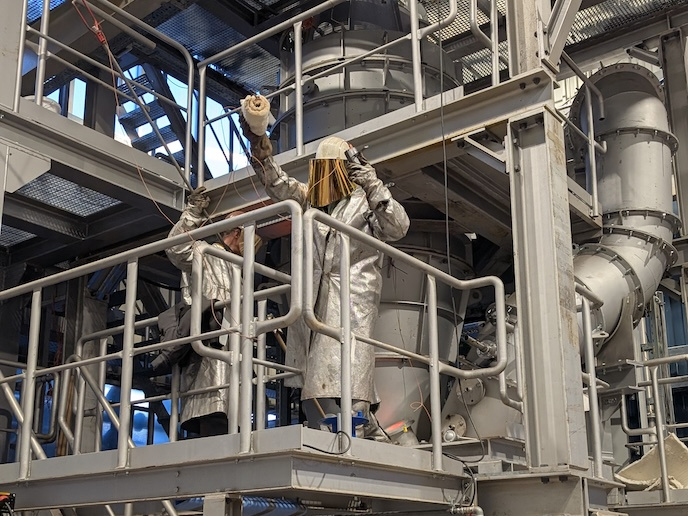
The FlashPhos process consists of three steps that harness different technologies. In a newly developed Dryer-Grinder, the moist sewage sludge is dried and ground simultaneously to a fine dry powder necessary for the second stage. The second stage involves an entrained flow reactor in which the sewage sludge powder is converted, at high temperatures, into a gaseous fuel and a phosphorus containing slag. In the final step, the phosphorus is reduced from the slag and transferred into the gas phase, from which it gets separated in the form of white phosphorus. “We tested the process in three pilot studies which, I am delighted to say, went really well,” says Schmidberger. In total, three pilot plants were developed: a Dryer-Grinder, Flash Reactor and Refiner. The Dryer-Grinder was first located in Straubing, and after some time transported to Stuttgart, in Germany. The Flash Reactor and Refiner are located in Leoben, Austria. The team faced technical challenges, recalls Schmidberger. The Flash Reactor runs at very high temperature, of around 1 500 °C to 1 600 °C. “When you factor in the chemical properties of the sewage sludge ash and the heat, the process is very stressful for the reactor material, especially refractory lining!” Various tests were performed to ensure the protective, heat-resistant layer installed inside high-temperature industrial equipment, called the refractory lining, was durable, and simulations were performed to analyse the temperature control in the reactor.
Extracting phosphorous while also providing an alternative to concrete
FlashPhos provides a technical solution for two issues – providing a disposal route for sewage sludge and reducing European dependency on phosphorus imports. As Schmidberger notes, given how widely used phosphorous is, the current situation is far from ideal: “There are practically no natural phosphorus sources available in Europe, so we are completely dependent on imports from countries like Kazakhstan and Vietnam.” So, as sewage sludge contains a significant amount of phosphorous, it is a relevant secondary raw material for closing the gap in phosphorus supply needs with recovery technologies such as FlashPhos. FlashPhos also provides a new disposal route for problematic, phosphor-rich wastes. “This combination of a disposal route with a recovery of phosphorus as white phosphorus in a circular economy approach makes FlashPhos so special.” A further benefit is the production, during the final step in the process, of two by-products that are in great demand: a slag with hydraulic properties is produced that can be used as an alternative to cement, along with an iron alloy that can be exploited in steelmaking.