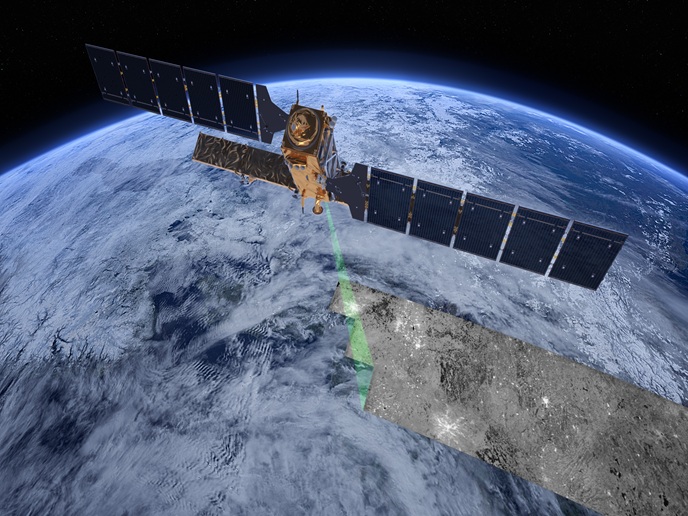
An orbital depot run by robots for in-space repairs

The viability of a wide range of future space missions will depend on finding ways to reduce the cost of putting spacecraft into orbit – and beyond. The European Commission envisages a future In-Space Operations and Services(opens in new window) (ISOS) infrastructure that extends the operating life of spacecraft through in-orbit maintenance and refuelling. “We aim to make space operations as self-sustaining as possible, avoiding consecutive single missions for deliveries or repairs, generating space debris and emissions,” says project coordinator Mathieu Deremetz, robotics, mechanisms and structures lead at Space Applications Services(opens in new window) in Belgium. STARFAB(opens in new window) has advanced the technologies needed to automate goods storage, handling and transport in space. “While most space station designs focus on hosting humans, to reduce risks and costs, ours, somewhat uniquely, looks to robots,” he explains.
Laying the rails for future space systems
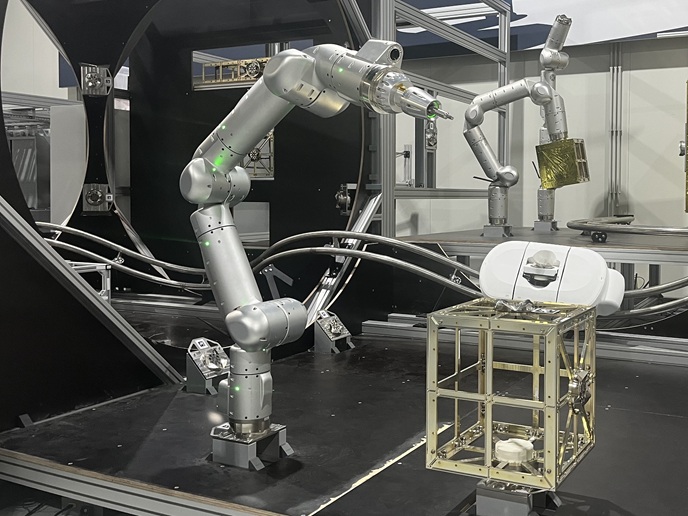
The STARFAB consortium of five European partners developed an orbital depot concept where spacecraft can dock to collect and deliver payloads, undergo maintenance and be refuelled. The STARFAB hub’s primary structure is a backbone of rails that hold robotic systems and stores of commonly needed spare parts such as pumps, storage tanks and battery units, known as orbital replacement units (ORUs). The structure also supports units to provide storage, propulsion, communication, guidance systems and power supplies. HOTDOCK(opens in new window) interfaces created by Space Applications Services connect and secure the payloads to transport and handling structures. “These vital anchor points mitigate the unique microgravity conditions of space, ensuring the robotic systems remain powered and connected at all times,” notes Deremetz. Key to this concept is a robotic arm developed under the EU-supported MOSAR project, which is designed to assemble modular satellites in orbit. Supported by machine vision systems, STARFAB envisions service robots working semi-autonomously, overseen by ground controllers.
Modelling the warehouse system
Inspired by pre-existing Earth logistics solutions, STARFAB developed two potential arrangements for the depot. For volume and efficiency, ORUs can be stacked in racks like goods in a warehouse, although this requires the units to be equally sized, limiting each stack to a particular function. The second option is a robot attached to a central rail surrounded by ORUs of various sizes and payloads, which the robot can navigate to and retrieve as needed, similar to a vending machine. To validate the STARFAB concept, the team built a 1:1 scale model more than six metres long. Representing a section of the depot, it comprised a rail, ORU storage unit, robotic arm, shuttle, and satellite under ‘repair’. The model successfully demonstrated two scenarios. In the first, the robotic arm retrieved an ORU before travelling by shuttle to install it on a satellite. In the second, robotic tools and vision subsystems were used to assemble a small satellite. In preparation for proof of concept launches planned under the European Space Agency’s Odyssey orbital refueller programme(opens in new window), the team is now working to ensure the in-space suitability of STARFAB’s modular building blocks. In addition, some of the technologies developed in STARFAB will also be used in the EU-funded EPRIME project, which is designing the HOST platform for the EU ISOS4I Pilot Mission(opens in new window). “Validating our automated orbital hub concept helps lay the foundations of a sustainable space economy built around reusable infrastructure rather than single-purpose missions,” concludes Deremetz.