



From festivals to farms: European regions turn wastewater into agricultural resources

Vast amounts of nutrient-rich wastewater disappear daily into urban sewers, while farms relying on conventional fertilisers struggle to maintain yields and cope with water scarcity. What cities have in excess agriculture often lacks. Bridging this gap is emerging as a practical route to cleaner water, stronger food systems and a more circular European economy.
Turning local problems into circular opportunities
The EU-funded P2GreeN(opens in new window) project is showing how cities and rural areas can reconnect resource flows by transforming wastewater, urine and faeces into safe agricultural inputs. “For too long, nutrients from human excreta have been treated as waste in cities and were not recognised as a valuable resource for agriculture. Our aim was to reconnect these two systems through safe, circular resource flows,” explains project coordinator Isabell Szallies. Pilot regions in Germany, Spain and Sweden implemented nutrient recovery systems(opens in new window) tailored to specific local environmental pressures. On the Swedish island of Gotland, seasonal tourism places heavy pressure on wastewater systems, contributing to nitrogen and phosphorus releases into the Baltic Sea. These nutrients fuel algal blooms and oxygen-poor waters that damage marine ecosystems. By recovering nutrients before they enter conventional wastewater systems, local authorities could reduce nutrient leakage. In the North German Plain, nutrient losses from agriculture and wastewater affect groundwater, rivers and coastal zones. In Spain’s Axarquía region, water scarcity creates competition between agriculture, residents and tourism, making efficient water reuse increasingly important. Rather than treating these as separate issues, P2GreeN approached them as one connected challenge. This challenge focused on how to reduce pollution while recovering valuable resources.
Putting circular approaches into practice
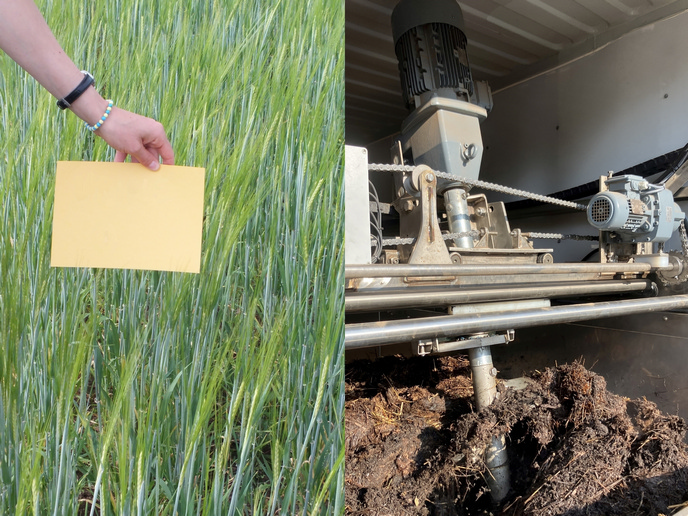
Across the pilot regions two main circular approaches were implemented in real operating conditions. The first captures nutrients before they enter conventional sewage systems. The second reclaims water and nutrients from treated wastewater for agriculture. In Sweden, urine was collected at festivals and event sites, then stabilised and processed into dry fertiliser which was used in agriculture. In Germany, dry separation toilets installed at festivals and public spaces collected urine and faeces separately. Urine was converted into concentrated liquid fertiliser, while faecal matter was composted into soil improvers. Both these examples demonstrated how public events can become local nutrient collection points instead of sources of wastewater pollution. In southern Spain, wastewater received additional filtration and disinfection before reuse. A smart fertigation tool then adjusted nutrient content to crop needs, allowing reclaimed water to irrigate mango and avocado orchards while also supplying fertiliser. Collectively, these practices reduced the amount of nitrogen and phosphorus entering wastewater treatment plants and lowered nutrient leakage into rivers and coastal waters. The recovered nutrients also reduced dependence on synthetic fertilisers and pressure on scarce freshwater resources while maintaining agricultural productivity. Beyond environmental gains, the pilots demonstrated new local value chains linking urban waste streams with nearby farms. This creates opportunities for circular business models and regional innovation.
Replicating local success stories
Many European territories face similar pressures from water scarcity, nutrient pollution or fertiliser dependency. P2GreeN’s methodologies are designed for replication, and the consortium has already started to explore how its models could be adapted elsewhere(opens in new window). The pilots showed that nutrients recovered from cities can already be reused safely in nearby agriculture, reducing pollution, saving water and creating new regional value chains. Nonetheless, the concept requires regulatory frameworks(opens in new window) and social acceptance(opens in new window). According to Dr. Stefan Karlowksy from the Leibniz Institute of Vegetable and Ornamental Crops (IGZ): “Our pilots showed that circular nutrient systems can work in very different local settings, from festivals in Sweden to drought-affected farms in Spain. But long-term adoption depends on cooperation between municipalities, farmers and citizens.”